

How Preventive Maintenance Software Reduces Downtime
Every piece of equipment fails eventually. The question is whether that failure happens on your terms or its own.
Unplanned equipment downtime is one of the most expensive operational events a business can face. It stops production, delays jobs, frustrates customers, and generates emergency repair costs that are almost always higher than the preventive maintenance that would have avoided them. In industries where equipment is central to service delivery — construction, facilities management, rental, fire protection, manufacturing — a single unexpected failure can cascade into a day of lost productivity, a missed client deadline, or a safety incident.
Preventive maintenance software exists to shift the balance. Instead of responding to failures after they happen, organizations that run structured preventive maintenance programs service equipment on schedule, catch deterioration early, and make informed decisions about repair.
This article explains how that shift works in practice — the scheduling mechanics, the role of inspection history, the automation that makes it sustainable at scale, and the measurable impact on downtime and repair costs.
The Core Problem with Reactive Maintenance
Most organizations start with reactive maintenance by default. Equipment runs until something goes wrong, then it gets fixed. The logic is straightforward: why service something that isn't broken?
The answer is cost. Reactive maintenance is almost always more expensive than preventive maintenance, for several compounding reasons.
Emergency repair premiums — when equipment fails unexpectedly, parts need to be sourced quickly, often at above-market cost, and technicians need to be redeployed at short notice. Emergency call-out rates apply. Lead times on specialist parts extend the downtime window.
Secondary damage — a component that fails because it was not serviced on schedule frequently damages adjacent components on its way out. A bearing that seizes takes a shaft with it. A filter that blocks causes a pump to run dry. The original fault is a fraction of the total repair bill.
Operational disruption — the cost of the repair itself is often smaller than the cost of the downtime it causes. A construction site standing idle. A rental asset off-fleet for a week. A facilities management team managing client complaints while an HVAC system is offline.
Shortened asset lifespan — equipment that is consistently maintained lasts longer. Organizations running reactive maintenance programs replace assets years earlier than necessary, at capital costs that dwarf any savings made by skipping service intervals.
None of these costs appear on a single invoice. They accumulate across the business in ways that are easy to absorb individually and significant in aggregate.
How Preventive Maintenance Software Changes the Equation
Scheduled maintenance that runs itself
The foundation of any preventive maintenance program is a reliable schedule. Every asset needs a defined service interval — whether based on calendar time, hours of use, distance travelled, or condition triggers — and someone or something needs to ensure those intervals are met.
In a manual system, that someone is usually a spreadsheet, a calendar reminder, and a person with enough time and discipline to follow up consistently. In practice, schedules slip when workloads peak, staff turn over, or assets move between sites.
Preventive maintenance software automates this entirely. Service intervals are configured once per asset type. The system generates upcoming work orders automatically, assigns them to the right technicians, and sends reminders before the deadline — not after it has passed. Overdue tasks are flagged in real time, visible to managers without anyone needing to chase them.
The result is a maintenance schedule that runs with the consistency of a system rather than the reliability of a person under pressure.
Maintenance history that informs decisions
A scheduled service visit is more valuable when the technician arriving knows the full history of the asset they are servicing. When was it last serviced? What was found? Were any issues flagged but deferred? Has this component failed before?
Without a centralized asset management software platform, this history lives in paper records, individual technician knowledge, and spreadsheet logs that are incomplete by definition. When that technician leaves, the history goes with them.
Preventive maintenance software maintains a complete, asset-level service record that is accessible to anyone with the right permissions, from any device, regardless of who has previously worked on that asset. Technicians arrive informed. Managers can see patterns across the fleet. Decisions about repair versus replacement are based on data rather than instinct.
Automated reminders and escalation
A maintenance schedule that generates work orders automatically is only as good as the follow-through. Preventive maintenance software adds a layer of automated reminders and escalation logic that keeps tasks moving without manual intervention.
Upcoming service windows trigger notifications to assigned technicians. Overdue tasks escalate to supervisors. Assets approaching critical service intervals are flagged before the window closes. If a scheduled inspection reveals a fault that requires immediate attention, a corrective action can be raised and tracked within the same system.
This automation removes the administrative overhead of maintenance coordination — the follow-up calls, the status checks, the manual reporting — and replaces it with a system that surfaces the right information to the right people at the right time.
Time-based service intervals work well for assets with predictable wear patterns. For assets where condition varies based on usage intensity, environment, or operating load, condition-based maintenance is more precise and more cost-effective.
Modern preventive maintenance software supports condition-based triggers — service intervals that activate based on hours of use, sensor readings, inspection outcomes, or usage thresholds rather than calendar time alone. An asset used heavily triggers a service sooner. An asset in light use extends its interval.
This approach reduces unnecessary service visits on low-use assets while ensuring high-use assets are never stretched beyond their safe operating window. The net effect is lower maintenance cost per asset and better allocation of technician time.
The Impact on Downtime
The relationship between preventive maintenance and downtime reduction is direct. Assets that are serviced on schedule fail less frequently. When they do develop faults, those faults are identified during planned inspections rather than during operational use.
The difference in downtime between a fault identified during a scheduled service and a fault that causes an unexpected breakdown is the difference between a planned maintenance window and an emergency repair event. The first is measured in hours. The second is measured in days.
For organizations managing large asset fleets, the aggregate reduction in unplanned downtime from a well-run preventive maintenance program is substantial. Industry research consistently estimates that preventive maintenance programs reduce unplanned downtime by 30 to 50 percent compared to purely reactive approaches — with corresponding reductions in emergency repair costs.
The organizations that see the strongest results are those where preventive maintenance is integrated with inspection workflows, so the data captured during routine inspections feeds directly into maintenance scheduling. An inspection that identifies early-stage wear on a component can trigger a service visit before that component fails — closing the loop between what technicians observe in the field and what the maintenance schedule prioritizes.
Industry Applications
Construction
Plant and equipment on construction sites operates in demanding conditions and is subject to regulatory inspection requirements. Preventive maintenance software helps construction businesses maintain compliant service records for every asset, schedule equipment inspections around project timelines, and reduce the equipment failures that cause costly site delays.
Facilities Management
Facilities teams managing large, heterogeneous asset bases across multiple sites benefit significantly from automated scheduling. HVAC systems, lifts, fire safety equipment, and building infrastructure each carry their own service intervals and compliance requirements. Preventive maintenance software consolidates this into a single schedule, ensuring nothing falls through the gaps as workloads fluctuate.
Rental Equipment
For rental businesses, asset availability is revenue. An asset that is off-fleet for an unplanned repair is a lost hire. Preventive maintenance software schedules servicing around hire cycles, tracks condition at every handover, and ensures the fleet is maintained to a standard that minimizes breakdowns in the field and disputes with customers.
Manufacturing
Production equipment downtime has a direct and immediate impact on output. Preventive maintenance programs in manufacturing are focused on maximizing equipment availability and extending asset lifespan. Condition-based maintenance triggers are particularly valuable in manufacturing environments where operating loads vary significantly between production runs.
An organization running preventive maintenance software effectively typically sees the following within the first six to twelve months:
- A reduction in unplanned breakdowns as scheduled maintenance catches deterioration before it becomes failure
- Lower average repair costs as secondary damage from run-to-failure events decreases
- Improved technician utilization as reactive emergency callouts are replaced by planned service visits that can be scheduled efficiently
- Better asset lifecycle data that supports capital planning and replacement decisions
- Audit-ready maintenance records that satisfy compliance requirements without additional administrative work
The transition from reactive to preventive maintenance does not happen overnight. It requires accurate asset registers, configured service intervals, and consistent inspection completion. But the foundation is straightforward to build with the right asset management software in place — and the return on that investment compounds over time as the maintenance history deepens and scheduling becomes more precise.
Frequently Asked Questions
What is preventive maintenance software? Preventive maintenance software is a platform that automates the scheduling, tracking, and management of planned maintenance activities for equipment and assets. It generates work orders on defined service intervals, assigns tasks to technicians, sends reminders, and maintains a complete asset-level maintenance history.
How does preventive maintenance software reduce repair costs? By ensuring equipment is serviced before it fails, preventive maintenance software eliminates the emergency repair premiums, secondary damage costs, and extended downtime that characterize reactive maintenance. Assets maintained on schedule also last longer, reducing capital replacement costs.
What is the difference between preventive and reactive maintenance? Reactive maintenance addresses equipment after it fails. Preventive maintenance services equipment on a defined schedule to prevent failure. Preventive programs are consistently more cost-effective at scale because they avoid the compounding costs — emergency parts, technician callouts, operational downtime, secondary damage — that unplanned failures generate.
What industries benefit most from preventive maintenance software? Any industry that depends on equipment availability benefits from preventive maintenance software. Construction, facilities management, rental equipment, manufacturing, fire protection, and healthcare all see strong returns — particularly where equipment downtime has direct operational or compliance consequences.
How does preventive maintenance software integrate with inspection workflows? The most effective implementations connect inspection and maintenance in a single platform. Faults identified during routine inspections trigger corrective actions or service visits within the same system, so the data captured in the field directly informs maintenance scheduling. AssetPool Nova is built to support this end-to-end workflow.
Reactive maintenance feels like the path of least resistance until you add up what it actually costs — in emergency repairs, secondary damage, operational disruption, and shortened asset lifespans.
Preventive maintenance software replaces that reactive cycle with a structured, automated program that keeps equipment running, catches deterioration early, and builds a maintenance history that supports better decisions over time. The impact on downtime and repair costs is measurable, and it compounds as the program matures.
For organizations managing significant asset bases, the question is not whether preventive maintenance delivers a return. It is how quickly you want to start seeing it.
AssetPool Nova is available to explore now via a free trial. book a demo to see how preventive maintenance and inspection workflows work together in a single platform.
For more context on what unstructured maintenance tracking costs in practice, read the hidden costs of manual inspections and maintenance tracking. To understand how Nova's asset management capabilities support preventive maintenance at scale, read Introducing AssetPool Nova: Reimagined.
Related Posts
.png?width=393&height=200&name=safetyculture-alternatives-blog%20(1).png)
SafetyCulture alternatives
SafetyCulture (formerly iAuditor) is one of the best-known inspection apps in the world. It is easy to use, has a large template library and offers a...
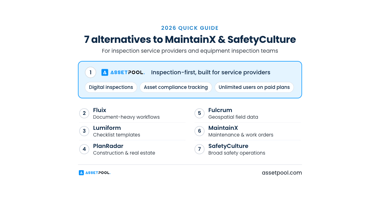
7 Best MaintainX and SafetyCulture Alternatives in 2026
MaintainX and SafetyCulture both earned their reputations in maintenance and safety checklists. But if your work centers on inspections, compliance...
CAN/ULC-S536 Reporting Requirements: Canadian Fire Professionals
Our software is used by Canadian fire departments, fire alarm service companies, and organizations across Canada to manage inspections, assets,...