

The Hidden Costs of Manual Inspections
At first glance, paper-based inspection forms and spreadsheet maintenance logs seem like a perfectly reasonable way to manage operations. They're familiar, they require no training, and they cost almost nothing to set up.
But "almost nothing" is doing a lot of heavy lifting in that sentence.
The real costs of manual inspections and maintenance tracking are rarely visible on a single line item in your budget. They hide inside delayed decisions, missed service windows, administrative hours, equipment failures, and compliance gaps — each one small on its own, but collectively significant enough to affect your bottom line, your team's productivity, and your ability to scale.
This article breaks down exactly where those costs accumulate, and how organizations in construction, fire protection, facilities management, and rental industries are eliminating them with digital inspection software and preventive maintenance software.
The Illusion of Low Cost
Manual systems feel cheap because their costs are indirect. You're not paying a software subscription. You're not onboarding a platform. You're just printing forms and updating a spreadsheet.
What you don't see on the invoice:
- The 45 minutes a technician spends transcribing paper notes into a system after each job
- The follow-up calls to verify whether an inspection was actually completed
- The hours your operations manager spends chasing down overdue maintenance records
- The cost of an equipment failure that a missed inspection would have prevented
These are real labor costs. They're just distributed across your team in ways that make them easy to overlook.
1. Administrative Time: The Silent Budget Drain
In most manual operations, field technicians fill out paper forms on-site, then return to the office to enter that data into a spreadsheet or log. Operations staff then review, file, and distribute those records. If a report is needed, someone compiles it manually.
This process is entirely duplicated. The same information is recorded twice — once in the field and once in the office — by two different people.
What this looks like in practice:
A facilities management company with 10 field technicians, each spending 30 minutes per day on data entry and paperwork, loses 25 hours of productive labor every week. Over a year, that's more than 1,200 hours — equivalent to roughly 30 weeks of one full-time employee.
That's not a hypothetical. It's an arithmetic problem.
Modern digital inspection software eliminates data duplication entirely. Technicians complete inspections on a mobile device; the data is instantly available to operations teams, managers, and clients without any re-entry.
2. Missed Inspections and Maintenance Windows
Paper-based maintenance scheduling relies on someone remembering — or on a calendar reminder — to assign, follow up on, and confirm inspections. When schedules change, staff turn over, or workloads spike, things fall through.
A missed preventive maintenance visit on a fire suppression system, HVAC unit, or rental fleet asset isn't just an inconvenience. Depending on the asset, it can mean:
- Equipment failure and unplanned downtime — the average cost of unplanned industrial equipment downtime is estimated at $260,000 per hour for large manufacturers (Aberdeen Group)
- Failed regulatory audits — in industries like fire protection and healthcare, missed inspections can result in fines, licence issues, or liability exposure
- Voided warranties — many equipment warranties require documented preventive maintenance at specified intervals
Preventive maintenance software automates this entirely. Inspections and service visits are scheduled based on time intervals, usage data, or condition triggers. Automated reminders go to the right people. Overdue tasks are flagged before they become failures.
You move from reactive firefighting to a predictable, auditable maintenance cycle.
3. The Cost of Poor Data Quality
Handwritten inspection forms introduce a consistent set of data quality problems:
- Illegible entries that require follow-up to interpret
- Incomplete forms where fields are skipped under time pressure
- Inconsistent terminology — one technician writes "minor corrosion," another writes "surface rust," a third writes "discolouration." All three mean the same thing, but your data doesn't know that
- Lost or damaged paperwork that creates gaps in compliance records
These aren't edge cases. They're the norm in any manual system under real-world operating conditions.
Poor data quality has a compounding effect. When you can't trust your records, you can't make confident decisions about asset health, maintenance priorities, or resource allocation. You end up over-servicing some assets out of caution and under-servicing others because the records suggest they're fine when they aren't.
Digital inspection software enforces structured data capture — dropdown fields, mandatory photo attachments, conditional logic that prompts technicians when anomalies are detected. The result is consistent, searchable, reportable data that you can actually use.
4. Delayed Reporting and Slow Response to Issues
In a paper-based system, the time between an issue being identified in the field and someone in the office knowing about it can be hours or days. The technician finds a problem, notes it on the form, returns to base, and the form eventually makes its way to the right person.
During that window, the problem sits unaddressed.
For industries where response time matters — fire protection, healthcare equipment, rental fleet management — this lag is operationally costly. A piece of rental equipment flagged as needing repair but still being dispatched to a job site. A fire suppression system with a noted fault that isn't escalated until the next audit.
Digital inspection software surfaces issues in real time. When a technician marks a fault or raises a corrective action on-site, the relevant person is notified immediately. Work orders can be triggered automatically. Clients can be updated without a single phone call.
5. Scaling Breaks Manual Systems
Manual processes have a hidden ceiling. They work tolerably when your operation is small. As you grow — more assets, more sites, more technicians, more clients — the cracks widen.
Adding five new sites to a manual system doesn't just mean more paperwork. It means more risk of errors, more administrative overhead per employee, more coordination complexity, and more compliance exposure. The system that "worked fine" at ten sites becomes genuinely unmanageable at thirty.
Organizations that wait until the pain is acute before switching to digital tools spend more on the transition, because they're doing it under pressure, with messy legacy data and ingrained habits to overcome.
Industry Spotlight
Construction
On active construction sites, equipment inspections are both a regulatory requirement and a safety necessity. Paper-based systems struggle with the pace of site activity, the number of assets in rotation, and the frequency of subcontractor involvement. A missed scaffold inspection or an unrecorded plant maintenance check creates liability exposure that no project manager wants.
Fire Protection
Compliance is non-negotiable in fire protection. Every inspection must be documented, traceable, and retrievable on demand. Paper records that are incomplete, misfiled, or simply lost don't satisfy that requirement. The cost of a failed audit or a liability event far exceeds the cost of any software solution.
Facilities Management
Facilities teams manage large numbers of assets across multiple sites with varying service intervals. Without automated scheduling and centralized records, maintenance windows are missed, service histories are fragmented, and client reporting becomes a manual exercise that consumes hours each month.
Rental Equipment
Rental fleets require pre- and post-hire inspections for every movement. Without a digital system, damage disputes are resolved by memory rather than evidence, and maintenance history is scattered across paper logs that don't travel with the asset.
What the Shift to Digital Actually Looks Like
Switching from manual processes to digital inspection software and preventive maintenance software doesn't require a long, disruptive implementation. Modern platforms are designed for field deployment — mobile-first, offline-capable, and configurable without technical expertise.
The shift typically delivers:
- Immediate reduction in administrative time — most organizations see this within the first month
- Full inspection history accessible from any device, with complete audit trails
- Automated preventive maintenance scheduling with reminders and escalation workflows
- Real-time visibility for operations managers and clients
- Consistent, structured data that supports business decisions rather than undermining them
AssetPool Nova is built specifically for organizations making this transition — whether you're running a ten-person field team or managing operations across multiple sites and industries.
Frequently Asked Questions
What are the main hidden costs of paper-based inspections? The most significant hidden costs are duplicated data entry labor, missed preventive maintenance windows leading to equipment downtime, poor data quality that prevents reliable reporting, delayed issue response due to slow information flow, and the scaling ceiling that manual systems hit as operations grow.
How long does it take to implement digital inspection software? Most modern platforms including AssetPool Nova are designed for rapid deployment. Field teams can typically be operational within days, with full configuration of inspection templates, asset registers, and maintenance schedules completed within the first few weeks.
Is digital inspection software suitable for small field teams? Yes. The efficiency gains from eliminating duplicated data entry and manual scheduling are proportionally just as significant for smaller teams, and the compliance and audit-readiness benefits apply regardless of organization size.
The costs of manual inspections and maintenance tracking aren't hidden because they're small. They're hidden because they're distributed — spread across technician hours, administrative time, delayed decisions, missed maintenance windows, and compliance risk.
When you add them up, the case for switching to digital inspection software and preventive maintenance software isn't a marginal one. It's clear.
The question isn't whether your organization can afford to make the switch. It's whether you can afford to keep absorbing costs that a better system would eliminate.
Related Posts
.png?width=393&height=200&name=safetyculture-alternatives-blog%20(1).png)
SafetyCulture alternatives
SafetyCulture (formerly iAuditor) is one of the best-known inspection apps in the world. It is easy to use, has a large template library and offers a...
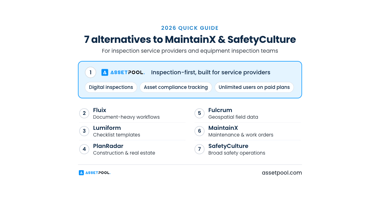
7 Best MaintainX and SafetyCulture Alternatives in 2026
MaintainX and SafetyCulture both earned their reputations in maintenance and safety checklists. But if your work centers on inspections, compliance...
CAN/ULC-S536 Reporting Requirements: Canadian Fire Professionals
Our software is used by Canadian fire departments, fire alarm service companies, and organizations across Canada to manage inspections, assets,...